The Legend of Zelda Breath of the Wild Review

Here's an unusual access for a reviewer to make. I haven't finished The Fable of Zelda: Breath of the Wild. I've yet to uncover swathes of its vast map. Much remains for me to exercise and discover, and my game is still rife with rumour, mystery and surprise. This is partly because my life is no longer compatible with monstering a behemothic open-earth game in a calendar week, fifty-fifty when information technology's work. Only information technology'south also considering of the kind of game that Breath of the Wild is.
The reason I feel comfortable telling you this is that this isn't a game that whatsoever one player can just know. Y'all can map it out, certain - spend weeks or months enumerating all its components and secrets. But the game'southward magic resides in its combination of sheer size with sheer openness, with apparently freewheeling yet meticulously interlocked systems, and with a scarcely apparent level of detail and craft in its making. When a game globe like this meets players, alchemy happens. My meandering and one-half-consummate run, full of digressions and doubling dorsum, feels as meaningful every bit the game of a completist, or of a player who skipped the chief quest to take a run direct at the end dominate with armour and weapons scavenged from the map'south darkest corners, or a player who chose to ignore the storyline altogether in favour of unlocking the mysteries of Hyrule'south nearly elusive Shrines, or of a player who simply headed north to see what lay there. Rarely has a game been so tempting to restart while you were still playing it.
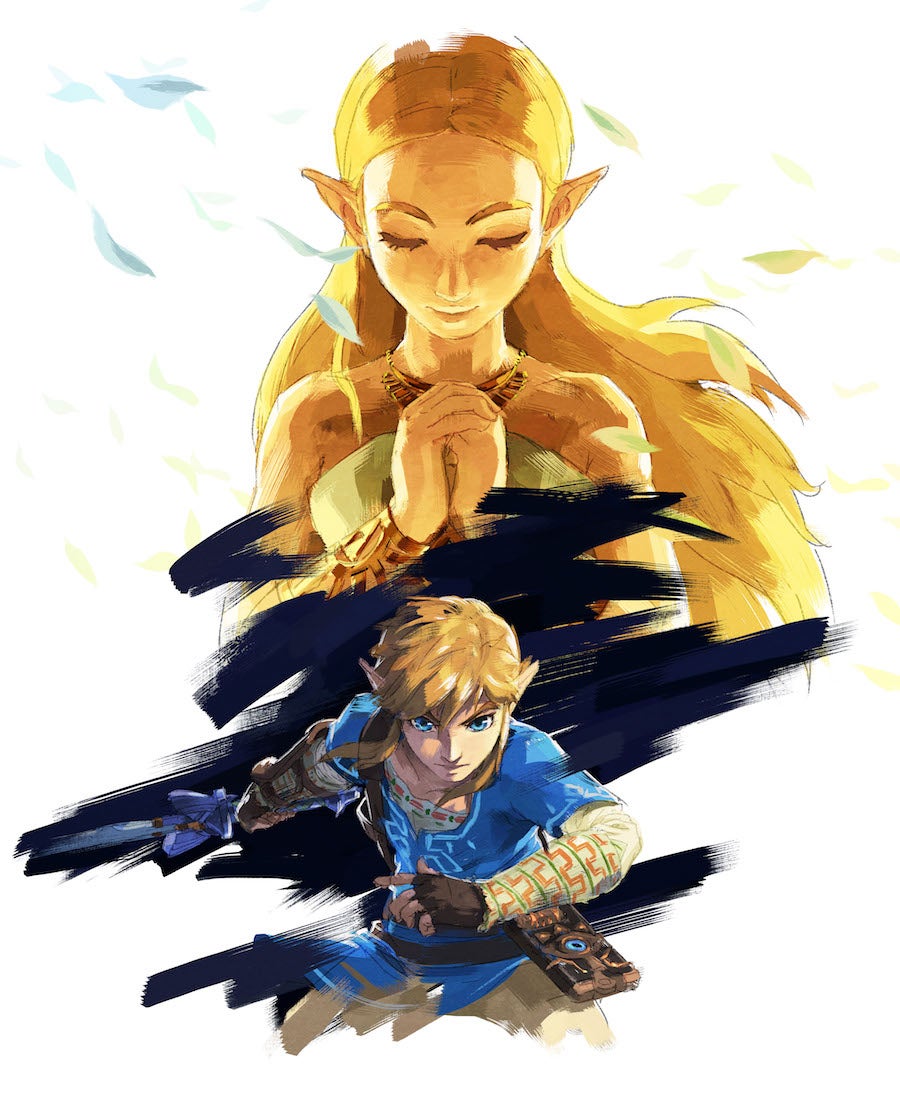
Our hero Link awakes on a high plateau in the middle of Hyrule's rugged vastness. Sheer cliffs driblet off all effectually, which conveniently confines us here until we've learned the ropes and earned the paraglider that will guide us safely down to the world beneath. Simply those cliffs are too there to give usa an unhindered and honestly breathtaking view over the world nosotros're about to explore, from cursed castle to hazy wetland, boiling volcano to parched desert. Amidst the misty watercolour washes of this fantasy landscape, y'all can pick out the precipitous glow and alien forms of ancient Sheikah technology: towers that fill in the map, and Shrines that house combat tests and physics puzzles. It's an incredibly promising view, and not a misleading 1. Nintendo'south starting time open world is up there with Azeroth and San Andreas as 1 of the greatest game worlds ever created.
Link, it turns out, has been asleep for 100 years, having failed with Zelda to defeat the apocalyptic evil known as Calamity Ganon. Ganon is independent at Hyrule Castle - equally is Zelda - but it's upwards to Link to take a second stab at him. If he wants help, he must journey to the 4 corners of Hyrule to rehabilitate the Divine Beasts, giant mechanical creatures originally created to defeat Ganon that take at present run amok. This is what you would consider the meat of a regular Zelda game - yet, while strongly advised, it'southward entirely optional.
On your travels you lot will meet the charming and familiar tribes of Hyrule: the aquatic Zora and avian Rito, the tubby rock-munching Gorons and the fierce Gerudo matriarchy which excludes all men from its desert city. The Korok - cute, rattling woodland sprites that beginning appeared in The Air current Waker - are here too, and they are vital to the tapestry of Jiff of the Wild. But y'all won't be guided to their well-subconscious homeland by any quest marker; you'll have to follow rumours and suggestions to find it and know its importance. That is every bit skillful an example as any of the remarkable conviction Nintendo's developers have in their world to draw players in, and the trust they take in those players to explore it freely and inquisitively. Few games in this waypoint-infested genre take that courage.
You'll likewise learn nearly the Sheikah tablet you're conveying, a sort of fantasy iPad that summons bombs and water ice blocks, and commands the forces of inertia and magnetism. Although you can upgrade it, its core abilities are all unlocked past the time y'all exit the starter surface area. Gear-gating - using the acquisition of new items to manage the player's progress through the game - is i of many thirty-year Zelda traditions that Breath of the Wild bravely discards, in favour of giving you pretty much all the tools early on and sending you off to discover your ain path. Bombs aside, the ability-ups yous get aren't the ones yous're expecting, and they upgrade in unpredictable means, branching off in new directions rather than only getting stronger.
Y'all'll likewise acquire more nigh what happened 100 years ago (Link is an amnesiac, of class) in a series of cutscenes. If Breath of the Wild has one weakness, information technology'south as a story. The grand events of the past seem remote from the teeming world around you, non to mention rather hackneyed, while the English language vocalization acting - sparingly used, thankfully - is stiff and cheesy. Unlike such soulful adventures as Ocarina of Time and Majora'south Mask, Breath of the Wild isn't unduly interested in ordinary people and their stories, and it musters neither the poignant niggling vignettes nor the strong emotional tenor of those games. It doesn't have the memorable characters and simple, pure narrative purpose of The Wind Waker, either. It's a shame - but it doesn't demand these things.
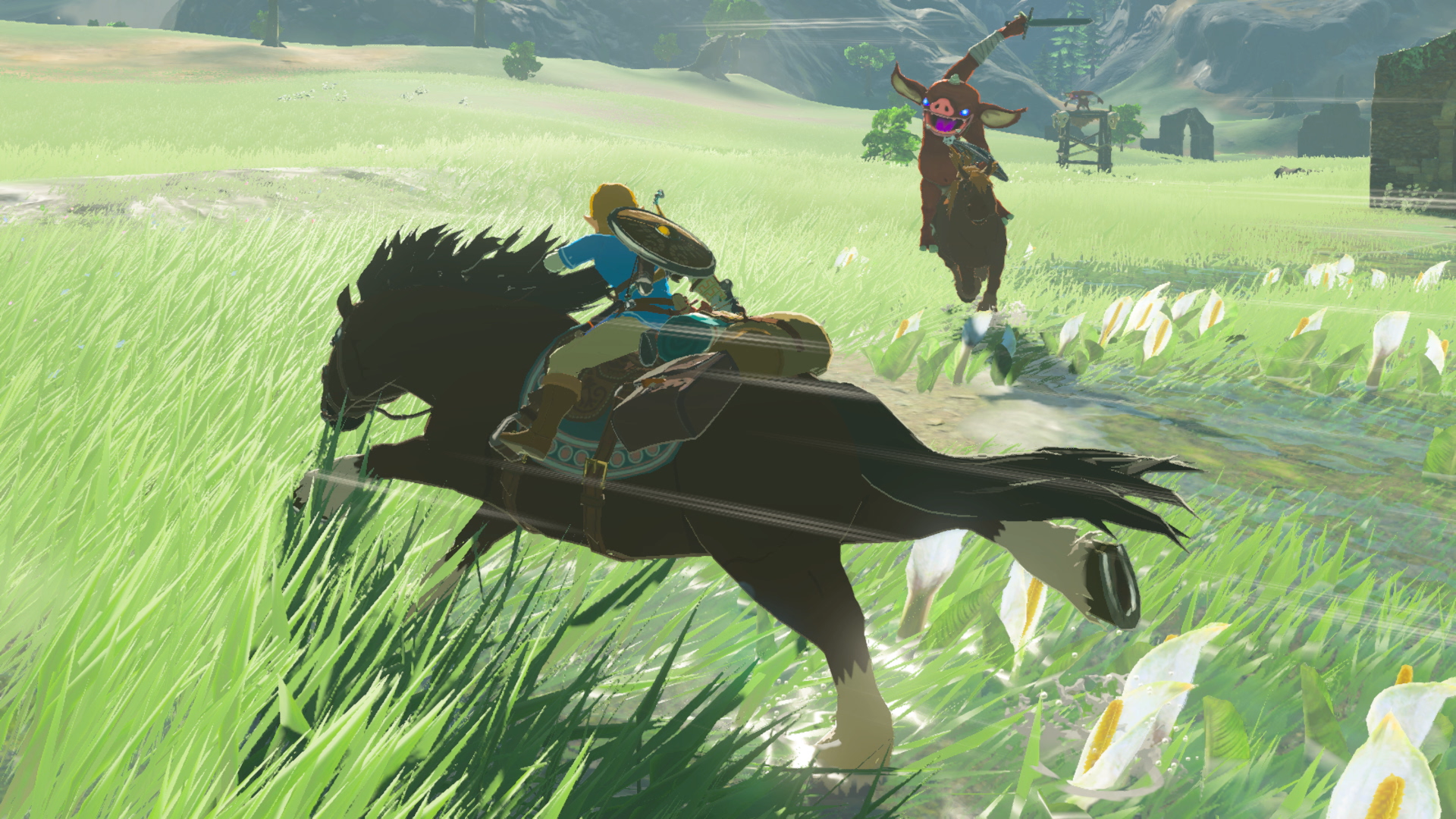
Arguably, a stronger storyline wouldn't have been compatible with Nintendo'due south decision to grant the player so much freedom. You really don't become this level of openness anywhere else this side of a Bethesda role-playing game. (The Elder Scrolls 5: Skyrim is an obvious inspiration.) You tin practise whatsoever yous similar, and go wherever you feel, greatly assisted by Link's ability to climb almost whatsoever surface. This is a game that wholly rejects artificial barriers. The further away you go from the center, the stronger monsters are, but at that place's no grind to meet their level and the ways to match them tin can be found just through exploring. Breath of the Wild too rewards your curiosity with abiding and dazzling inventiveness. Information technology'southward dumbfounding that such a vast space should be so packed with things to detect, observe and do.
The designers are squarely focused on keeping you lot out in this world, and for Zelda traditionalists, that ways one major and potentially painful prey: dungeons. There isn't anything you lot would describe equally a classic Zelda dungeon hither, no huge and devious labyrinth of locks and keys, boss fights and puzzles. The gameplay survives in the Shrines, which business firm the cleverest puzzles in chambers tinged with Portal'southward ascetic lab aesthetic, and out in the world, where boss monsters roam and elaborate combat gauntlets await. The Divine Beasts are relatively compact merely extremely intricate and rewarding challenges that are probably the closest thing to a dungeon per se. Some Shrines take much longer to consummate than others, and are introduced by involved and mysterious quest lines.
Underpinning the whole game is an extremely strong and multifaceted suite of linked systems, including weather, stealth, cooking, and a fantastically fun and convincing physics simulation. (Even item drops from enemies are fully physically modelled.) Cooking, which provides useful buffs likewise equally refilling your wellness, isn't the recipe list you'd expect; it'southward a system where the same dish tin be conjured from different ingredients and at unlike potencies. It'south not about collection or rote learning, it's near agreement the rules and then improvising with what you have.
This is true of the game as a whole, peculiarly in combat, where all Breath of the Wild's tools and systems meet. In that location are so many variables in a fight - what yous happen to be holding, what your enemy is holding, if there are any fires or boulders around, if y'all're in the centre of a lightning storm and so need to unequip everything metal - that information technology's almost e'er improve to wing it and try new tactics on the fly than to settle into a groove. This is a game that can play similar Dynasty Warriors one minute and Metallic Gear Solid the next.
Nutrient buffs can help you out hugely if you're nether-equipped - and being over-equipped isn't always a good matter. Breath of the Wild's disposable weapons may evidence to be the most controversial aspect of its design; weapons habiliment out fast, and simply a few very special ones can be repaired. You're fifty-fifty encouraged to throw them away as they go worn downwards, every bit a well-placed lob will earn you a critical hit. It starts out stressful, but it's ultimately a liberating change that's reminiscent of Halo's weapon-swap philosophy. Information technology too has brilliant consequences for Breath of the Wild's sweeping reinterpretation of role-playing game convention.
With no feel points to grind, Link's progression is entirely dictated by gear: dress for defense and weapons for assail ability. A great weapon detect is doubly precious for existence temporary, so you won't want to waste its short life on weak enemies, and it'south always good to have one or ii lesser pieces on hand. Thus y'all're voluntarily scaling your ability to the situation at hand, which makes yous feel smart and still gives you a strong sense of advancement, without the boring effect of a level-balancing gear up-up such as Skyrim's. (Plus, all the equipment looks actually absurd, and collecting and upgrading Link's outfits is quite compulsive.)
What this all adds upward to is superb sandbox game design, free of fiddle or bloat, unencumbered with preconceptions, and executed with the rock-solid reliability, tactile feedback and arcade brio for which Nintendo is justly celebrated. In other words: a total curiosity.
In example it isn't clear, this is a very different Legend of Zelda game. Until very recently, Nintendo has made its games in a bubble - non that this was necessarily a bad affair, as its priorities were unique, and its standards were uniquely high, but information technology seemed quite unconcerned by what other game makers were up to. Zelda, one of the almost widely admired, finely honed and carefully iterated designs in gaming, was a bubble within this bubble. Its recurring plots almost the hero in green echoed its well-worn, smooth patterns of play: get the boomerang, hookshot and bombs, do the dungeons, save the girl. It was a ritual incantation, a myth that ticked like clockwork.
All that has been either swept aside or remade from beginning principles. It's difficult to overstate the backbone and conviction with which producer Eiji Aonuma, manager Hidemaro Fujibayashi and their team have rewritten their ain work, and the size of the risk Nintendo has taken with a beloved belongings. Jiff of the Wild isn't just the most radical departure from the Zelda tradition in its thirty-year history, it's the start Nintendo game that feels similar it was made in a world where One-half-Life two, Halo, Grand Theft Auto iii and Skyrim happened. Information technology'south inspired by those greats and others, simply information technology doesn't ape them whatsoever more information technology rests on its ain honour. And if nosotros're talking inspirations, nosotros have to recognise i game to a higher place all others, an uncompromising adventure from 1986 that dared to have gaming off the rails, that put a whole globe beyond the Tv screen and invited the player to explore it: the original Legend of Zelda.
Source: https://www.eurogamer.net/the-legend-of-zelda-breath-of-the-wild-review-7
0 Response to "The Legend of Zelda Breath of the Wild Review"
Post a Comment